







How PLM Actually Helps Engineering Teams Move Faster


For engineering teams to move as fast as we need them to, the people, product data, and processes that influence their work must remain fully aligned.
Every design change creates a ripple effect across upstream and downstream teams, making it harder to keep everyone working from the same information.
That is where product lifecycle management (PLM) comes in. Modern PLM software manages product information from idea to production.
PLM helps prevent version confusion, BOM mismatches, undocumented changes, and errors caused by manual handoffs.
But how does it actually help engineering teams move faster day to day?
Where engineering time really gets lost
As products become more complex with teams often distributed, engineers spend more time searching for information, verifying decisions, and confirming they’re working from the correct revision.
Engineering teams regularly need real-time answers to:
- Which BOM is current?
- Was this part approved?
- Who approved this change?
- Why was this component selected?
- Which revision did manufacturing receive?
Answering those questions shouldn’t interrupt engineering work. When information is difficult to find, teams lose time to rework, manual checks, and unnecessary back-and-forth.
Today’s PLM tools give engineers easy access to the information they need, so they can spend more time designing and less time searching.
Engineering teams need one trusted product record
A trusted product record gives engineering, procurement, and manufacturing a single source of truth throughout product development. It gives every team confidence they are working from the correct revision.
Research has shown that 85% of PLM users say these systems help them find information more easily, nearly 75% report more accurate data, and more than two-thirds say they have more timely access to design information.
With one trusted product record, engineering can release designs with confidence, procurement can review approved parts and alternates, manufacturing can build from the right revision, and leadership can track progress without relying on status meetings.
PLM shortens engineering change cycles
Engineering changes rarely affect just one component. They can impact assemblies, suppliers, drawings, test plans, manufacturing processes, and compliance documentation.
Without PLM, those impacts are often managed through email threads, chat messages, shared spreadsheets, and informal knowledge. As products, teams, and supply chains grow, managing those changes manually becomes much harder.
Today’s change management should be much more “GitHub-inspired”, with the ability to track revisions to parts, drawings, and BOMs; see who changed what and why; route ECOs through approval workflows; notify reviewers; and reduce the number of rejected change orders caused by missing data.
When change orders are complete, visible, and routed automatically, teams spend less time chasing approvals and more time solving engineering problems.
PLM brings sourcing decisions into engineering earlier
For Octopart users, this is one of the most important speed advantages of PLM: it helps engineering and sourcing collaborate before component choices become expensive to change.
For example, integrating Duro PLM into your workflow allows engineering teams to save hours of time manually copy/pasting component data by leveraging Duro’s API access to Octopart.
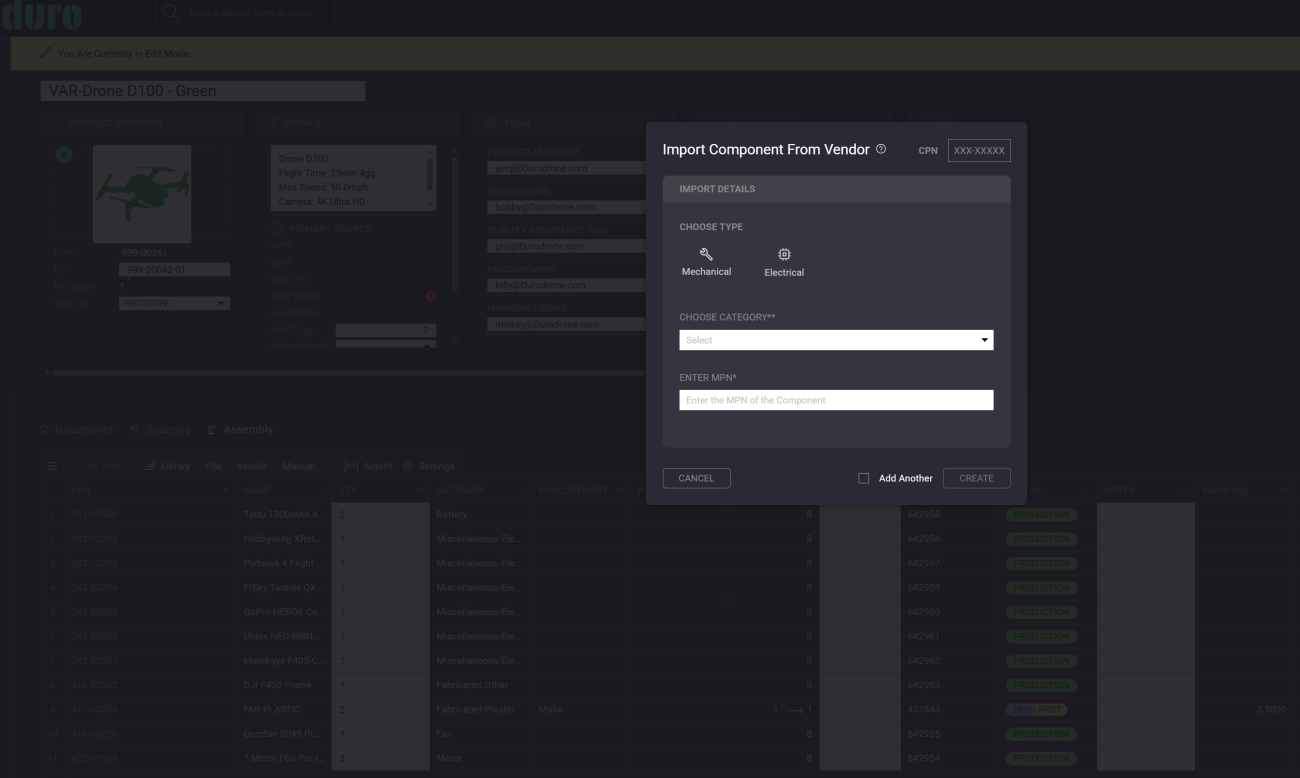
Then, once a component is added, pricing data (in addition to any other data) can be refreshed directly from within the PLM to give your team up-to-date accuracy. This also saves hours of manual price checks, providing more decision-making time for teams to pivot to a different component if costs become untenable, or worse, unavailable.
This is the ROI of PLM for Octopart users. A product can be hard to launch if parts are unavailable, obsolete, too expensive, or difficult to source. When sourcing review happens after the design is mostly complete; teams are forced into late-stage tradeoffs, delaying the schedule or redesigning under pressure. PLM is designed to help teams get the data they need much earlier in order to make decisions that reduce time-to-launch. Engineers can view supplier, lifecycle, cost, availability, and alternate part data in the context of the design.
PLM improves cross-functional collaboration
One of the biggest barriers to faster product development is sequential handoffs. Engineering finishes a design, then sends it to sourcing. Sourcing finds an issue, then sends it back.
PLM allows cross-functional teams to review designs and contribute earlier in the development process.
Manufacturing can inspect the design before release, procurement can flag risky parts while the BOM is still evolving, and quality can validate requirements before the release package is complete.
This is especially important for distributed teams. PLM gives them a shared product record so development can continue without relying on constant meetings or manual status updates.
PLM preserves the “why” behind engineering decisions
Hardware products that live for years require product memory, especially as engineers leave, suppliers change, and components go obsolete.
When decision context is stored in someone’s memory, an old email thread, or a local spreadsheet, teams eventually lose the reasoning behind the design.
PLM helps preserve the “why” alongside the “what.” A good product record should answer:
- Why was this component selected?
- Why was this alternative rejected?
- Why was this tolerance changed?
- Which supplier approved this revision?
- Which ECO introduced this requirement?
- Which assemblies are affected if this part changes?
A product should carry its own memory so teams don’t have to solve the same problems every time a question resurfaces.

About Author
Related Resources
Related Technical Documentation
Table of Contents
Solutions for Every Role and Team
- Discover and evaluate design options earlier
- Develop in one shared workspace
- Scale with control and compliance
- Connect every stage of hardware development
Learn More
Thank you, you are now subscribed to updates.