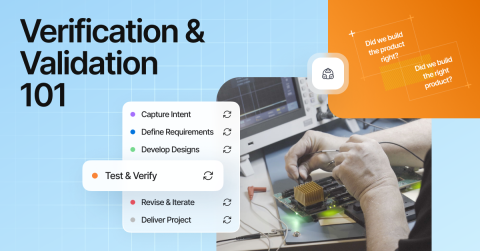












Requirements Engineering in Hardware Development

At a Glance
Learn how requirements engineering, its core definitions, and structured processes apply to hardware product development.


Let's be honest: very few people get excited about requirements. Yet, every hardware team has felt the cost of unclear requirements: rework that shows up late, or a build that misses what stakeholders actually asked for.
Requirements engineering (RE) is the discipline that follows a structured process of defining, documenting, and managing requirements so the final product solves the right problem. When applied well, it catches mistakes early, keeps the team aligned, and gives everyone confidence that what ships is what was actually agreed to build.
However, the term is often confused because it has roots in both software engineering and systems engineering of hardware products.
In this article, you'll get a clear definition of requirements engineering and its role in hardware product development. We cover both a theoretical overview and a practical framework of how it is applied in a hardware project, with real-world examples and a list of the most common pitfalls, and how to avoid them.
Key Takeaways
- Requirements engineering helps hardware teams turn design intent into clear requirements and keep everyone on the team aligned.
- Requirements guide the project from early planning and design through testing, changes, and final documentation.
- A good requirements process helps dev teams catch problems early, avoid costly redesigns, and ensure the final product meets what was agreed.
What Is Requirements Engineering?
Requirements engineering is a systematic, disciplined approach to defining, documenting, and managing requirements during hardware product development.
It helps teams understand the problem that needs to be solved, clarify and analyze stakeholder needs, resolve conflicts and trade-offs, document what the product must achieve, and keep that understanding up to date as the product evolves.
In practice, requirements create a shared understanding between stakeholders and engineering teams of what is being built, why it is being built, and how the team will know whether the final product meets the design intent.
Benefits of Requirements Engineering
When RE is done well, it helps prevent misunderstandings and costly mistakes, keeps the team aligned, and helps make sure the final product meets its requirements.
The main benefits of RE include:
- Shared Vision: Keeps stakeholders, managers, and engineering teams aligned around the same understanding of what is being built.
- Clear Scope: Makes it clear what is part of the project and what is not, helping prevent uncontrolled additions known as scope creep.
- Reduce Costly Mistakes: Helps find problems in requirements early, before they become expensive design rework, new prototypes, or repeated testing.
- Improves Planning and Scheduling: Gives teams a clearer picture of what needs to be built, making it easier to estimate work and create realistic timelines.
- Improves Product Quality: Helps make sure the final product does what was agreed and meets the required quality standards.
Evolution of the Requirements Engineering Discipline
Requirements engineering has roots in both systems engineering and software engineering. These two lineages developed in different engineering contexts, so the term can still have a slightly different scope depending on the source.
In the software engineering context, the focus is primarily on software development requirements: what the software should do, how it should behave, and what quality attributes it should meet. Software engineers think of functional and non-functional requirements documented as user stories, use cases, and acceptance criteria. In the systems engineering context, the scope is wider. Requirements refer to the entire system, including hardware, software, people, processes, interfaces, operating conditions, and other system characteristics. System engineers talk about system-level requirements allocated down into hardware, mechanical, electrical, firmware, and safety-factors, recorded as formal requirement statements and requirements traceability matrices.
In hardware development, RE brings together both perspectives. It combines the rigor and multidisciplinary scope of systems engineering needed to deal with bill of materials (BOM) costs, thermal constraints, and manufacturing limitations, with the lifecycle traceability used in software engineering to keep requirements testable and connected throughout development.
Related Disciplines to Requirements Engineering
Requirements engineering is closely related to other product development disciplines, especially systems engineering and product management.
Systems Engineering
Systems engineering views a product as a complete system. A systems engineer makes sure that different parts such as hardware, software, mechanical parts, and testing work together properly and do not conflict.
This is closely connected to RE because requirements give all of these teams a common reference for what the product needs to achieve.
If you like analogies, imagine building a house. Different specialists work on the foundation, electricity, plumbing, and heating, but someone still needs to make sure all of those parts actually fit together into one complete structure. Systems engineering plays that exact role in product development.
Product Management
Product management helps decide what to build and why. Product managers talk to customers, study the market, look at competitors, and work with the business to decide which problems are worth solving and which features matter most.
This is also connected to RE because those high-level customer needs and business goals become the starting point for defining product requirements.
Phases of the Requirements Engineering Process
The RE process can be organized in different ways depending on the application area, the people involved, and the organization. In some projects, activities happen mostly one after another, while in others they’re repeated and revisited as the team learns more.
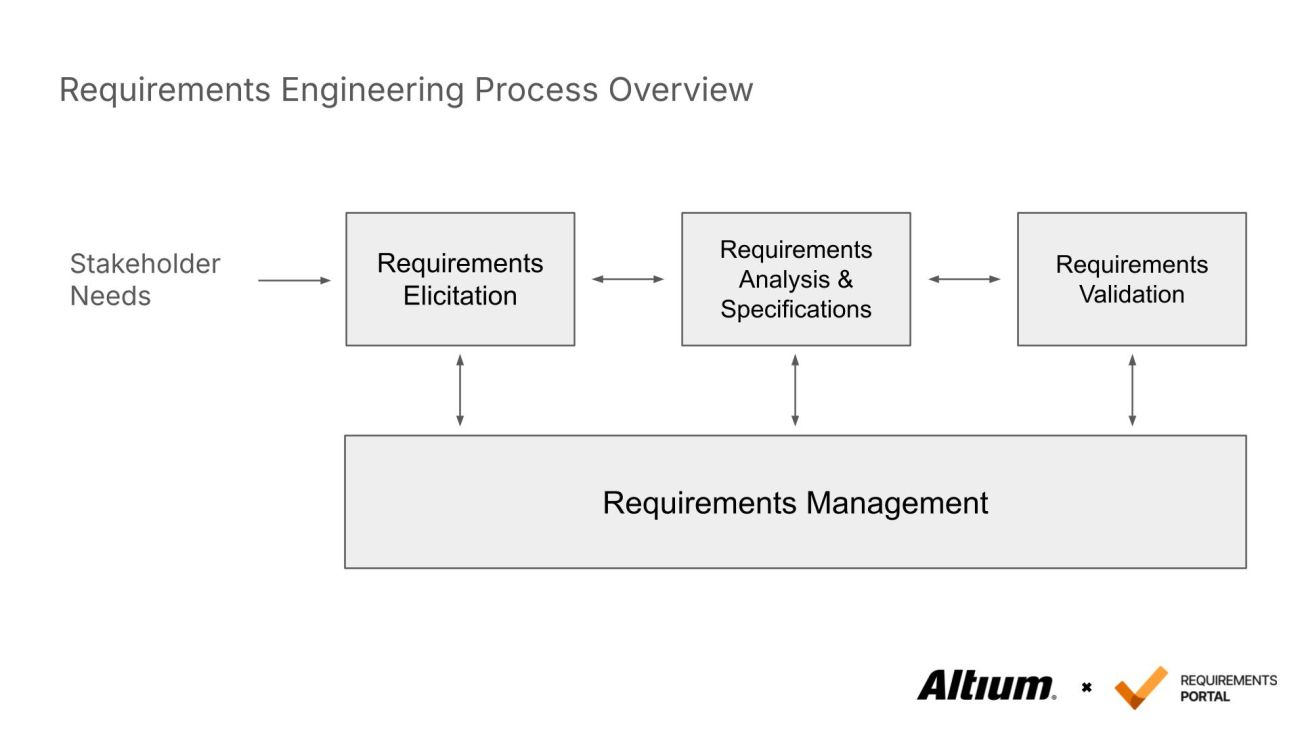
As described in an article published in the Requirements Engineering journal, a common textbook approach breaks the RE process into four core activities (phases):
- Requirements elicitation: gathering requirements from stakeholders and other sources to understand what the system must do and under what conditions it must operate.
- Requirements analysis and specification: reviewing what was gathered, resolving unclear or conflicting information, and turning it into clear requirements the engineering team can use.
- Requirements validation: checking that the requirements are correct, complete, and describe what the system is intended to achieve.
- Requirements management: tracking requirements and their changes over time, including why they changed and what other requirements, design work, or testing may be affected.
Who’s Involved in the Process
Several key roles are involved in the RE framework, working together to define what a product should do:
- Requirements Owner: The engineer who takes vague stakeholder needs, asks the right questions, and turns them into a set of requirements the engineering team can actually use for product development. This is often a Systems Engineer, Lead Engineer, or someone with similar responsibility.
- Technical Product Leadership: The people who communicate with the stakeholder/business side, understand their needs, and then turn that request into a clear product goal. This may include Product Managers, Program Managers, or similar roles.
- Implementation Engineer: The engineer who uses those defined requirements to design and build the product. This may include Electronics, Mechanical, Software, or Firmware Engineers.
- Verification Owner: The person who decides how the requirements will be tested and makes sure the necessary reviews and tests are completed. This may include Verification Engineers, Test Engineers, or QA Engineers.
Practical Requirements Engineering Framework for Hardware Development
While the four activities above define the core of the RE process, hardware teams need a practical way to apply them throughout a project.
The following is a practical view of the requirements engineering framework for hardware development, showing how requirements fit into each stage.
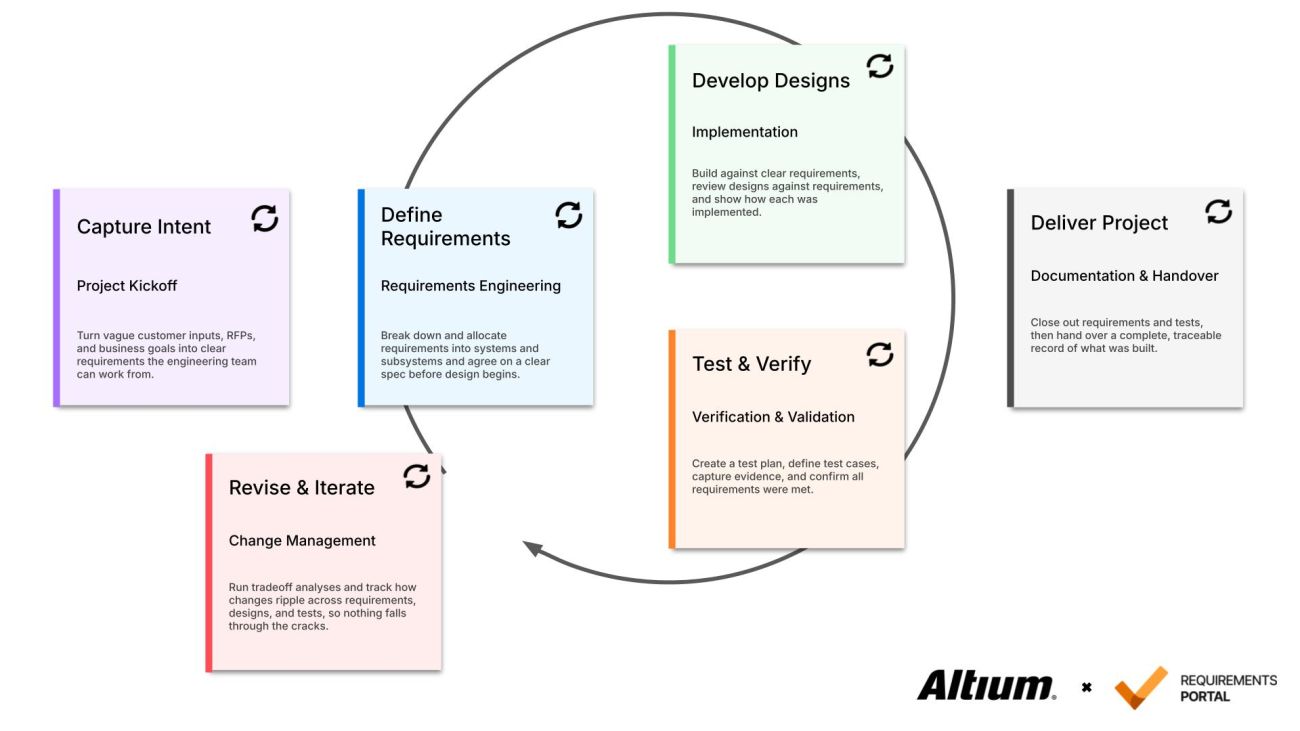
Project Kickoff: Capture Intent
At the start of a project, Technical Leads usually receive vague inputs such as customer requests, requests for proposal (RFPs), business goals, or constraints on cost, size, or schedule. For example, a customer might ask for a smaller device that supports a specific use case.
Together with the Requirements Owner, Technical Leads clarify what's needed and turn those inputs into high-level requirements that describe what the product should achieve.
Requirements Engineering: Define Requirements
The high-level requirements from the Project Kickoff phase are still too broad for detailed design. In this phase, the Requirements Owner defines the overall system, breaks it into parts and subsystems, and turns those high-level requirements into more specific requirements for each part.
They also check that the requirements do not conflict, that nothing important is missing, and that each one is clear and testable. The result is an agreed set of requirements that the engineering team can use as the starting point for product design.
Implementation: Develop Designs
Implementation Engineers use the agreed requirements to design and build their part of the product, whether that means creating a schematic, modeling a 3D part, or writing software or firmware. As the design develops, they link each requirement to the design feature that satisfies it. These links create the project's traceability and help the Requirements Owner see how the requirements have been implemented.
Verification & Validation: Test & Verify
Requirements also define what to check during reviews and testing. The Verification Engineer defines how each requirement will be checked and works with the Implementation Engineers to perform the necessary reviews, measurements, or tests, and records the results. This connects what the product was required to achieve with the evidence showing whether it actually achieved it.
Change Management: Revise & Iterate
Requirements and product designs often change during development. A requirement may prove impossible to meet, a component may become unavailable on the market, or a new constraint may appear. When this happens, the Requirements Owner tracks what changed, why it changed, and which requirements, design parts, or tests are affected.
Documentation & Handover: Deliver Project
At the end of the project, the Requirements Owner works with the Verification Engineer and the rest of the team to close out requirements, design reviews, and verification activities. The final documentation should provide a traceable record of what was required, what was built, and how it was verified. Customers, manufacturers, auditors, or teams that continue working on the product will need this information later.
Requirements Engineering Examples
Requirements Engineering in Medical Devices
Requirements Engineering is used across medical and care technology products. Requirements stay with the product throughout development. Teams turn stakeholder needs into structured system requirements, keep them connected as specifications change, and use them to plan verification and document test results.
Medical devices add a regulatory layer. Teams put more effort into traceability, verification, and documentation and paperwork. This supports regulatory clearance under frameworks such as FDA 21 CFR Part 820 in the US and ISO 13485:2016 in the EU and other markets.
“The structured approach to documenting requirements has streamlined our workflow, making it easier to manage and organize project specifications effectively.” — Alf-Einar Løberg, Department Director, Sensio |

The HitIQ mouthguard is an example of a medical wearable where safety needs dictate every technical spec. Discover how it’s done in the full Customer Success story.
Requirements Engineering in Consumer & Industrial Electronics
The core requirements engineering process is similar across consumer and industrial electronics, but the products are built under different conditions. Consumer products like smart home devices or wearables sell in high volumes and launch fast. Industrial products like programmable logic controllers (PLCs) or motor drives have to run for years in harsh conditions.
In both cases, teams write down what the product must do, link each requirement to the design, update requirements when something changes, and test against them.
What changes is where teams put the extra effort. In consumer electronics, it goes into keeping up with fast changes, because one misunderstood requirement can mean redesigning the board. In industrial electronics, it goes into verification, because the product has to be tested for long life and harsh conditions before it ships.
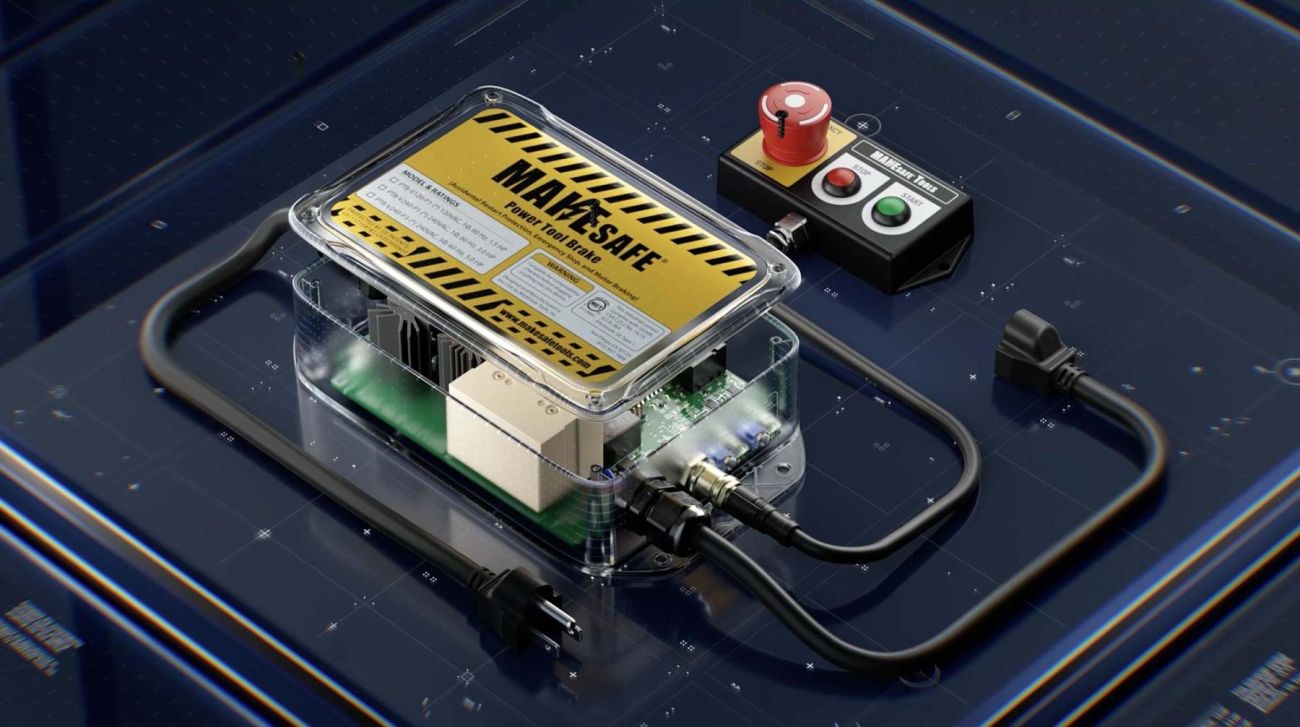
To build reliable hardware that complies with safety regulations, keeping requirements and design changes connected is key. Read how MakeSafe Tools manages this in the full success story.
How to Avoid Common Requirements Engineering Pitfalls
Requirements engineering comes with some common challenges. Knowing what can go wrong makes it easier to spot problems early and avoid them during hardware product development.
Here are some of the most common pitfalls to watch out for and how to avoid them:
Common Pitfall | How to Avoid It |
Defining project requirements before getting enough input from the right stakeholders. | Involve the right stakeholders early, ask enough questions, and fully understand their needs. |
Adding or changing requirements without checking their impact first. | Review every new or changed requirement before accepting it, and check how it affects scope, schedule, cost, and testing. |
Writing requirements that can be interpreted differently or can’t be verified. | Make requirements clear, measurable, and verifiable. |
Managing a growing requirement set in spreadsheets and losing traceability | Move to a dedicated requirements management tool that can scale and maintain traceability as the project grows. |
Spending too much time managing requirements. | Reduce requirements busywork with purpose-built AI. |
Software Tools for Requirements Engineering
Managing a small set of requirements is relatively simple. As a project grows, keeping everything organized and up to date takes more effort. At that point, the way you manage requirements starts to matter more.
In practice, teams usually work with one of these approaches:
- Spreadsheets and Docs: Familiar and easy to start with, which makes them useful for smaller projects. As the project grows, however, they require more manual work to maintain.
- Dedicated Requirements Management (RM) Tools: Provide more structure and control as projects become more complex. The trade-off is that some tools also bring more process than a smaller team may need.
The goal is to use enough structure for the project without making requirements management more complicated than it needs to be.
For smaller hardware teams that have outgrown spreadsheets but do not need a large enterprise RM workflow, Requirements Portal is a practical option to consider. It is designed to give smaller teams a more structured way to manage requirements without the overhead of a traditional enterprise system.
Conclusion & Next Steps
At this point, you should have a clear understanding of the main requirements engineering concepts and how they apply in practice.
If you want to continue learning about requirements engineering, these resources are a good place to start:
- ISO/IEC/IEEE 29148:2018 provides the international standard for requirements engineering processes and practices. It gives you additional guidance on how requirements should be written, structured, documented, and managed.
- NASA Systems Engineering Handbook gives practical guidance on how requirements are created, written, checked, and used during system development.
- Guide to the Systems Engineering Body of Knowledge (SEBoK) explains how requirements fit into the bigger systems engineering process and how different parts of a system are developed together.
- Requirements Engineering journal publishes research, industry examples, and different approaches to requirements engineering in more depth.
If you are ready to move from theory to practice, try Requirements Portal and start working with structured requirements on a real hardware project today, for free and with no setup required.
Frequently Asked Questions
Why Is Requirements Engineering Important?
Requirements engineering matters because it helps the team build the right product by clearly understanding stakeholder needs before design and development go too far.
What Is the Role of a Requirements Engineer?
A requirements engineer turns stakeholder needs into clear requirements the engineering team can use, and keeps those requirements organized as the project changes. They act as a bridge between clients and development teams.
What Is the Difference Between Requirements Engineering and Requirements Management?
Requirements engineering is the entire process of finding out, understanding, and writing down what a system needs to do in the first place. Requirements management is the specific part of that job that keeps those requirements organized and tracks any changes once they are written.

About Author
Related Resources
Related Technical Documentation
Table of Contents
- Key Takeaways
- What Is Requirements Engineering?
- Benefits of Requirements Engineering
- Evolution of the Requirements Engineering Discipline
- Related Disciplines to Requirements Engineering
- Phases of the Requirements Engineering Process
- Who’s Involved in the Process
- Practical Requirements Engineering Framework for Hardware Development
- Requirements Engineering Examples
- How to Avoid Common Requirements Engineering Pitfalls
- Software Tools for Requirements Engineering
- Conclusion & Next Steps
- Frequently Asked Questions
Better Requirements
Less Busywork
Build better hardware with AI agents that live and act in your requirements tool.
Learn More
Thank you, you are now subscribed to updates.