
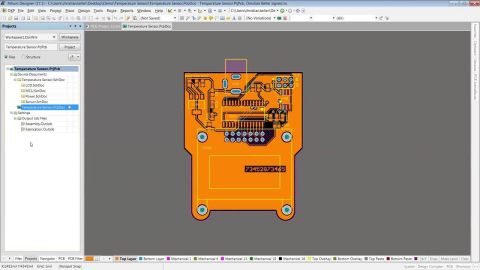
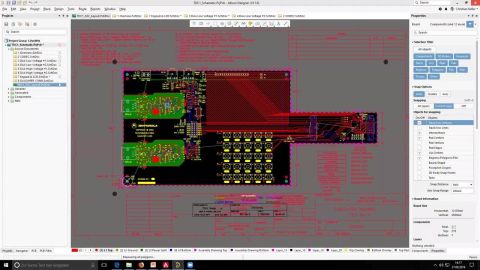
Watch our webinar on schematics as part of the Altium Academy Virtual JUMPSTART Series (part 1).
Get familiar with the Altium 365 browser-based interface, from registering an Altium Account and signing in to accessing your Personal Space and available Workspaces. This article introduces the interface’s main navigation areas, account controls, and ways to switch between Workspaces, with details on supported sign-in methods and administrator-controlled authentication. Keep reading to navigate…
Altium 365 can host a Git repository for your project's source files. Altium Designer works with these repositories as a native client, but you can also work with them like any other Git remote — clone, pull, push, etc. with the standard Git client. This page shows how to: Discover a project's repository URL through the Altium 365 API. Authenticate Git requests using an Altium 365 access token…
Scopes define what an access token is authorized to do. The Altium 365 API validates scopes on every request – a token without the required scope for an operation will receive an authorization error. Scopes are assigned by the platform based on the context in which a token is issued. You don't select scopes manually, but you will encounter them when inspecting tokens and when working with the API…
The refresh token flow is a more secure way to authorize API requests. Instead of using a single long-lived credential directly, you exchange a refresh token for a short-lived access token. When that access token expires, you exchange again. Note that the refresh token cannot be used by itself to authorize API requests; it always has to be exchanged for a refresh token first. To use this flow,…
An access token authorizes requests to Altium 365 API. You include it in every request as a bearer token in the Authorization header. Access tokens can be obtained in two ways: Directly – when you create a long-lived access token in Admin → Developer Via exchange – when you use a refresh token to generate a short-lived access token (which will not be listed under Admin → Developer) The…
Tokens are credentials used to authorize requests to the Altium 365 API. All API requests must include a valid token in the Authorization header. Tokens are created in your Workspace under Admin → Developer. Only Workspace administrators can create tokens. Tokens are shown once. At creation, the token value is displayed once and is never stored or retrievable by Altium. Copy and store it securely…
A GRID (Global Resource ID) is a globally unique, stable identifier for any entity on the Altium platform – a project, a component, a BOM, a task, and so on. Why GRIDs Exist Platform entities typically carry local identifiers (GUIDs, numeric IDs) that are unique only within their own context. A project GUID is not globally unique – two projects in different Workspaces can share the same GUID. A…
A realm is a named, isolated logical instance of Altium 365. Every Workspace belongs to exactly one realm, and all data within that Workspace is stored and processed within it. Why Realms Exist Altium 365 operates across multiple geographies and deployment models. Historically, the term region was used to refer to a single instance of Altium 365 per geography – one for Europe, one for the US, and…
Altium Identity is Altium's OAuth 2.0 and OpenID Connect (OIDC) identity provider. Your application authenticates a user through Altium Identity and then calls the Altium 365 API on their behalf — it never handles the user's Altium password. Applications sign in with the authorization-code flow and PKCE. Public clients (desktop, on-prem, native, single-page apps) use PKCE with no client secret;…
This section takes a closer look at the following elements of the Altium 365 platform: Authentication – Altium Identity authentication flows Realms – each 'realm' is a named, isolated logical instance of Altium 365. GRID (Global Resource ID) – a globally unique, stable identifier for any entity on the Altium 365 platform. Tokens – credentials used to authorize requests to the Altium 365 API…
Learn More