







How to Choose the Best PCB Manufacturer for Your Project

At a Glance
Here’s how you can find and qualify the best PCB manufacturer for your new product.


PCB manufacturing is competitive, and there is plenty of worldwide manufacturing capacity for new boards. If you’re looking for a manufacturer for your next project, it can be difficult to determine who is the best option to produce your board. Different fabricators and assemblers offer different levels of service, different capabilities, and access to different processes and materials. There are a lot of options to consider when selecting a manufacturer for your project.
In this article, my hope is I can walk the intrepid designer through the thought process involved in choosing the best PCB manufacturer for a new project. You might be in a position where you need more advanced manufacturing services, or it might be your first time engaging with a full-service manufacturing firm. Either way, there are some questions you should ask your PCB manufacturer and yourself to ensure you decide on the best fabricator and assembler for your next project.
How to Find the Best PCB Manufacturer
I remember when I put my first batch of boards into production with a local manufacturer. I’ve always been a proponent of talking to manufacturers before you begin your design, and I’m glad I did this on my first run. They were very helpful in providing a rough cost estimate before finalizing the design, notifying me of available material options, and making sure I understood my responsibilities in getting something into fab.
This learning experience helped me formulate a set of questions I ask myself before I help a client get into manufacturing. Because my company works with defense firms who need PCB designs and manufacturing services, there are certain regulations to be considered when selecting a manufacturer. Here are some of the questions you might ask yourself before you start searching online for a manufacturing partner.
Fabrication, Assembly, or Turnkey?
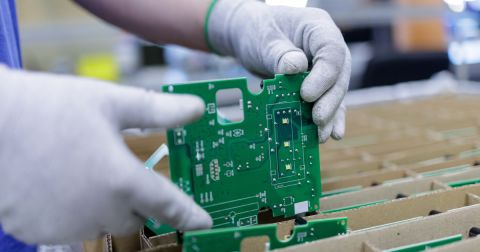
PCB manufacturing consists of two high-level steps: board fabrication and board assembly. Some firms only provide one service and not the other. The term “turnkey solution” also gets thrown around a lot when referring to PCB manufacturing, as well as in other industries like software. Very simply, a turnkey manufacturer provides fabrication, assembly, and component sourcing services into a single package. Some companies will offer fabrication with turnkey assembly through a partner as a single service package.
Before you order components, be sure to check the assembler’s attrition requirements. Small components can sometimes get lost on the factory floor, so it helps to purchase 5% to 10% extra to account for this. If you don’t feel comfortable sourcing your components for a new project, or you don’t have time to go through the exercise, then a turnkey solution is a viable option. A turnkey manufacturer will add a markup to component costs (this can double your component costs in some cases), and they may add an additional fee to their regular fab + assembly costs.
What are the Feature Size Limits?
Not all manufacturers can reliably fabricate to very small line widths and line spacings. Fabricators may charge you more for smaller feature sizes, either on a function of board size or built into NRE costs. On the assembly side, if you’re working with fine-pitch BGAs or you’re placing BGAs on both sides of the board, be sure to check that your fabricator can accommodate these requirements. For small vias that might be needed for HDI, check that your fabricator can do laser drilling if required.

Certifications and Regulatory Compliance
If you’re manufacturing a medical device, an automotive product, military or aerospace hardware, or other regulated products, make sure your manufacturer has certifications attesting to their quality systems in these areas. Quality assurance programs are required for some products, and a manufacturer should be able to produce proof of compliance on demand. The best PCB manufacturers for regulated products will be able to spot any design choices that might reduce yield and reliability.
What Materials Can They Access?
Suppose you need a specialty PCB substrate material, like a metal-core board or a ceramic substrate. In that case, some manufacturers will subcontract this to one of their partners and apply a markup. Not all manufacturers routinely work with advanced materials, nor do they always keep them in stock. In addition to substrate materials, you might need a conformal coating for your board, or you might want plating other than HASL on exposed copper. Different manufacturers offer different service levels in this area, and you should carefully consider your requirements as you consult with your fabricator.
Quote, Design Review, and Release
Once you’ve found the best PCB manufacturer for your project, your design will go through several stages before it gets to a fab line. The design will need to pass a review before a price can be quoted, and the board can be released for production. If you’ve already gone through a process to ensure your board’s fab and assembly requirements match the manufacturer’s capabilities. You can rest assured you’ll have a high-quality product at the end of the process.
Once you’re ready to send your PCB off for fabrication, you can use the ActiveBOM utility and the complete set of documentation tools in Altium Designer® to prepare for manufacturing. The best PCB manufacturers are familiar with Altium Designer’s project files and formats, and they can ensure your design will be manufacturable at scale. When you’ve finished your design, and it’s time to share your project with your manufacturer, you can use the Altium 365® platform to share and manage your design data.
We have only scratched the surface of what is possible to do with Altium Designer on Altium 365. You can check the product page for a more in-depth feature description or one of the On-Demand Webinars.

关于作者
Related Technical Documentation
相关资源
Thank you, you are now subscribed to updates.





 沪公网安备 31010502006411号