







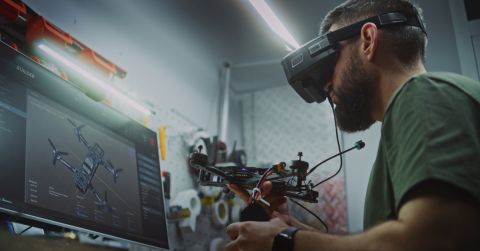

Breaking the Firmware Bottleneck with AI Native Developer Tools

At a Glance
Break the firmware bottleneck with AI-native tools. Generate drivers from datasheets and reach field testing faster.


Firmware and embedded engineers face a unique challenge: bridging the gap between hardware design and software implementation while working under tight constraints and mission-critical requirements.
In this episode of the Ctrl+Listen Podcast, Ryan Eppley (CEO) and Samarpita Chowdhury (CTO) of Root Access explain how their AI-native platform Hideout is transforming the embedded systems workflow. From generating accurate drivers directly from datasheets to eliminating tedious configuration work, discover how this New York-based startup is helping engineers go from schematics to field testing in days instead of months.The conversation explores what makes embedded engineering so challenging, why traditional AI coding tools fall short for low-level programming, and how Root Access is partnering with Altium and Octopart to create a seamless development environment.
Resources from this episode:
- Connect with Ryan
- Connect with Samarpita
- Root Access on LinkedIn
- Root Access on X
- Learn More about Root Access
Listen to the Episode
Watch the Episode
Key Takeaways
- Embedded and firmware engineering is uniquely hard because it sits at the intersection of hardware and software, with engineers needing deep knowledge of schematics, low-level code, and tight resource constraints on real devices.
- Modern machines (cars, robots, drones, industrial equipment) depend on hundreds or thousands of configured components, creating a firmware bottleneck where programming, reconfiguration, and validation can stretch projects from months into years.
- Mission-critical systems—medical devices, defense, safety equipment—cannot fail, which makes rigorous testing and conservative engineering culture essential and also slows adoption of new tools and approaches.
- Generic AI coding tools struggle with embedded work because they lack hardware context and must reason over datasheets, schematics, and tightly constrained architectures. Effective AI for embedded must be domain-specific and context-aware rather than “one size fits all.”
- Post-COVID, robotics and hardware are seeing a real-world boom, driving demand for embedded talent worldwide; at the same time, AI is emerging as a productivity “copilot” rather than a replacement, and engineers who ignore it risk being left behind.
Transcript
James: Hi, everyone, this is James from the CTRL+Listen Podcast, brought to you by Octopart. Today we have two special guests for you: Ryan Eppley, co-founder and CEO, and Samarpita Chowdhury, co-founder and CTO of a company called Root Access. Thank you so much for coming on the show.
Ryan: Yeah, absolutely. We're excited to be here.
James: You’re a pretty fresh company. This is a fairly recent public launch, so it's exciting to have you on this early. Maybe start with your personal journeys and careers, and then we’ll get into the company?
Ryan: Yeah. We haven’t even celebrated one year since incorporation, so it's been an exciting last ten or so months.
When we first met, I told you I grew up working on a farm in eastern Pennsylvania. Since I was 12, I was driving a tractor, digging ditches with a backhoe before I could even legally drive on the road, which I always found funny.
I met Samarpita at a hardware hackathon here in Manhattan. We’re both based in New York City. There were about 70 guys there, the whole kit and caboodle, as most of these meetups are. Within a couple of minutes, it was clear that Samarpita might be the smartest person in the room.
Without stealing her thunder, Samarpita, tell us more about your background.
Samarpita: I’ve always loved robotics and math since early childhood. I ended up doing both my bachelor’s and master’s in electrical engineering with applied math.
In my past experience, I was designing motherboards and processors for the military, and I also wrote firmware for them. I saw AI coming into the picture. My friends doing higher-level programming got 10x productivity from AI, but I couldn’t really use it for my kind of low-level programming. It just didn’t fit embedded work.
That’s when I met Ryan, and we started talking about this pain point. That led to how we started Root Access.
James: Fantastic. So, rolling straight from that into the company: do you want to explain the basics of what Root Access does and the process that led to where you are now?
Ryan: I had a clear direction of what I wanted to do. Since childhood, I’ve loved machines. I think they’re powerful and beautiful, with this interesting duality.
When I first met Samarpita, I kept telling her I either wanted to build our own machines or help the engineers who bring them to life. I initially saw her as a potential early beta user or customer—someone to give me feedback while I did customer discovery.
She told me she was working on motherboards at a critical level for the military and industry. It became clear that instead of being just an early customer, she was asking, “What if I could be a co-founder?”
We didn’t have a name yet. I just knew I wanted to help build the next generation of machines, and that it shouldn’t take three to four years for each one.
The real birth of the company was finding someone with deep expertise in embedded systems, all the way from schematic to board bring-up, and honing in on that critical handoff between hardware engineers using EDA tools like Altium and the firmware engineers who have to read those schematics and bring the board to life.
That process today is extremely tedious and manual. Most AI developer tools on the market aren’t focused on it and aren’t very good at it. That’s where we sit.
Our company is called Root Access, and the product is called Hideout, which stands for Hardware IDE. It’s our first attempt at a universal AI-native platform for programming hardware.
“Universal” means it can work across different boards and vendors with the same tool.
Samarpita, do you want to talk about how it's felt in your career having to jump between different hardware and different tools to program and debug them?
Samarpita: Yeah. Before this, I worked at a startup as a hardware engineer where I was both the hardware and firmware person. That handoff was easy because I designed the hardware and wrote the firmware.
Later I moved to a much bigger corporation where I was only the hardware engineer, and there was a separate firmware engineer. That created hours and hours of handoff—just explaining the design.
Every time we switched hardware, the firmware team pushed back: “This is a massive redesign. There’s no way we can reuse the existing code on this hardware.” Because it's so low level, every vendor has a huge learning curve. We’re here to solve that.
James: So the main concept I'm hearing is streamlining.
Ryan: Yeah. We want to help people go from schematics to field testing in days and weeks, instead of quarters and years.
People say hardware is hard because it's physical and there are supply chain issues, which is true. But it's also hard because if you swap any component—whether in a legacy system or during prototyping—you often have to reprogram and revalidate everything even before you get a physical prototype.
There’s a ton of work behind the keyboard that’s slowing down great innovation.
James: Fantastic. I’m sure you’ve touched on this already, but the term “firmware bottleneck” is something I’ve heard you mention in your mission statement. Can you explain what that is for people who might not know?
Ryan: Most people know what a hardware engineer is, and everyone knows what a software engineer is. There’s a special breed—firmware and embedded engineers—who sit at the crux of bringing hardware to life.
The firmware bottleneck has been building over the last several years, especially recently, as hardware becomes more complex. Think about the car you grew up riding in 20 years ago versus the car you drive today—all the sensors, cameras, ADAS, in some cases LiDAR. Now apply that to a bulldozer, a tractor, a tank, a satellite.
The firmware bottleneck is a core reason why it takes so long to build these machines. You must program and configure each individual electronic component within the system. Sometimes there aren’t just hundreds, but thousands of components. Each has clock settings, configuration registers, and so on that must be set correctly.
And it’s not just initial bring-up. There are firmware patches and updates along the way. That bottleneck is something we’re excited to help engineers move through faster with AI-native tools.
James: That makes sense. Connected to that, could you explain the concept of an AI-native developer tool for someone who works in another space?
Ryan: Samarpita, do you want to take that?
Samarpita: Sure. When I tried using generic AI tools, they weren’t good enough for embedded work. I write very low-level code and those models had no real context about the hardware actually on my desk.
AI-native, for us, means the tool has deep context about the hardware: the board, the chips, the peripherals. Then it writes application-level code on top of that specific hardware.
We also have specifically fine-tuned models just for embedded systems coding. So our AI-native developer tool is tailored to embedded engineers, not general software.
Ryan: Without going too deep into our secret sauce, we can share some breadcrumbs. There’s a lot of discussion about fine-tuning models with proprietary, well-organized labeled data. There’s also a lot of talk about RAG systems and context windows.
One challenge we ran into—and started finding breakthroughs in—is how to handle large amounts of context: datasheets, schematics, internal IP, all those assets. If you just dump them into a RAG system, the context window becomes huge. It’s very hard for LLMs to do their job well, and you get hallucinations.
Almost every embedded engineer we talked to initially is skeptical, especially in mission critical contexts. As one customer said, “I don't think anyone's ready to vibe-code a tank.” We totally agree.
So what do we do? We aggressively shrink the information in the context window before generating anything. That requires several proprietary models and a lot of fine-tuning. That’s what helps us avoid hallucinations on complex system-engineering tasks.
James: That makes sense. I’m sure people listening are thinking, “Okay, now I get it.”
To explain things a bit more, what are some specifics of embedded engineering that make it more complex than other spaces? What specialized needs make it stand out as a sector?
Ryan: Rarely do you jump straight into embedded systems from college, though some do. There’s computer science and electrical engineering, but there’s also computer engineering, which really mixes both.
Computer engineering students learn enough schematics to understand silicon and are still comfortable writing scripts and working in a terminal.
Many people, however, come from just electrical engineering and have to teach themselves to code, or vice versa. So a lot of embedded engineers need deep domain expertise in two worlds: hardware and software. That alone is a barrier to entry.
We think we can help by giving people tools that make them feel like they can ramp up faster: “I can enter this field and be productive quickly.”
On top of that, embedded systems are full of constraints. You're constantly fighting limited resources. As legacy systems get updated, components go end-of-life, and you swap in replacements. Then you have to rethink protocols, reconfigure peripherals, and so on.
You can’t just “spin up more cloud compute” on a microcontroller. There are strict timing, memory, and power constraints. That makes embedded engineering more complex than many other software fields.
That’s where people struggle—and where they get very excited when we show them what we’re building.
Samarpita: Another big issue is delays. Development cycles are very delayed. If you have a six-month deadline, it’s almost never shipped in six months. It becomes eight or nine months, or a year.
We need tools that cut that delay. Even reducing a cycle from eight months to seven is huge, and going under six months is something we really want to enable. That’s one reason embedded engineering has special needs.
James: Fantastic. I’m going to dive into Hideout in a minute, but one last broader question: you mentioned mission critical systems. That term gets used a lot—what does it actually mean?
Ryan: The most direct way to say it: lives are on the line.
It could be a medical device keeping a heart beating, equipment firefighters rely on, or hardware on the front lines in a war zone. There are moments where the machine must work. If it doesn’t, the repercussions can include loss of life.
Mission critical hardware is hardware that cannot fail. There is no “what if it crashes?” That’s why field testing and validation become so important and such a source of delay.
We really care about the machines that keep humanity safe and running, and we want to increase the availability of those machines by shortening the path to deployment.
James: That makes total sense. Thank you.
Let’s talk about Hideout in more detail. At this point, what’s available? What are we looking at for pricing? Can you give some basic product information?
Ryan: We shipped a CLI tool over the summer. That CLI uses the same engine that’s going into our full-fledged IDE. We’re very happy with early user feedback.
Hideout today can ingest all kinds of datasheets and, through several internal processes, generate drivers—even for parts our system has never seen before. We can generate accurate, portable drivers from scratch.
So you can imagine someone using Octopart to find a new component, downloading the datasheet inside our environment, and immediately generating accurate drivers. Then, if they want to swap the component, they go back to Octopart, pick a new part, and generate updated drivers in the same environment and validate their system.
Right now, the CLI tool is already in use by customers like Mitsubishi Electric and East West Manufacturing.
We’re also about to release our full-fledged IDE, built in-house, that takes everything people love about the CLI and adds more functionality and features for engineers.
Samarpita: Something I want to add is that at Root Access, we really focus on helping people spend more time on innovation instead of configuration. Embedded work involves a huge amount of configuration. We take care of as much of that as we can so engineers can focus on writing applications and innovative features.
James: That’s great. Anything else you want to touch on before we move into broader industry topics?
Ryan: Mostly just a little cliffhanger since I’m sure we’ll catch up again. Right now we’re very focused on MCUs. There’s a whole world of other architectures we’re excited to expand into.
Today, if you’re working with MCUs from STM, Texas Instruments, Renesas, or other major brands, we can support you. If you’re working on more exotic platforms, know that we’re thinking about you too.
James: Fantastic. I want to ask some broader industry questions about trends you’ve seen.
Post-COVID, it’s a different world in many ways. What changes did you see in embedded engineering pre- and post-COVID?
Ryan: It’s no secret that we’re seeing a sort of Cambrian explosion in robotics. Before COVID, robotics still felt futuristic, like something decades away.
Now, it’s either already in your workplace and you haven’t noticed, or your workplace just deployed its first robot. Warehouses, factories, logistics, agriculture—many industries are seeing real deployment.
Every robot runs on firmware and embedded systems. Post-COVID, we’ve seen a massive market for deployed robotics, not just lab research.
James: Definitely. The rate of acceleration has been astronomical.
That ties into my next topic: AI. It’s become a key aspect in many sectors. Have you seen AI affect the embedded systems space?
Samarpita: Yeah. A lot of people in embedded are very skeptical of AI. But it’s coming, and if you don’t get on the train, you’ll be left behind.
I use AI a lot in my day-to-day work. I never see it as something that replaces me. I see it as an assistant that boosts my productivity.
James: I think that’s the healthiest way to look at it. It’s a tool, not a replacement—at least at this point.
Ryan: Exactly. I see people excited about using AI to “vibe-code” a website or build a simple web app. That’s fun, but embedded work is much harder.
Writing firmware requires very specialized knowledge. Most customers we talk to are skeptical at first, especially in mission critical contexts. Then they see a demo and the fidelity of the output.
The first phase of AI over the last few years focused on consumer and early business use cases. Now we’re moving into enterprise and mission critical applications. That’s where we’re focused: making AI capable of very complicated, technical tasks.
James: So it’s a fine-tuning phase now. Are there any other trends in your space from the last few years you think are worth mentioning?
Ryan: More people want to get into hardware than ever. It’s “cool” again. Whether it’s cultural or driven by market demand, there are just more jobs.
I don’t remember talking to a large company that wasn’t trying to hire more hardware and firmware engineers. Everyone is in a hiring frenzy. The headlines focus on AI talent, but something similar is happening in hardware without the same media coverage.
We’re seeing lots of computer science grads who are, for the first time, going to their local makerspace, learning tools like Altium, and getting into hardware because they’re bored of building yet another web app. They want to touch the physical world and work closer to the metal.
We see students getting into hardware at university and very senior engineers wanting to move deeper into hardware-focused companies.
James: And there’s a critical shortage in this space in almost every country. By 2030 it’s going to be worse because demand keeps rising and there aren’t enough people graduating into these roles.
Ryan: Exactly. We want to help onboard the next five million embedded engineers. We’re very dedicated to that.
While we focus on enterprises that push the boundaries of what machines can do, we’re excited to support students and early-career engineers. There are great companies that have served enterprise for decades while offering free tools and educational outreach to students. We plan to do the same.
James: Altium is one of those companies as well, so it’s fantastic to see that.
That brings me to the end of my questions. Is there anything else you’d like to mention before we wrap up?
Ryan: Yeah. We’re very excited to have signed a strategic partnership with Altium and Octopart. We’ve already talked a bit about what we’re doing with Octopart.
Coming soon, you’ll be able to take schematics directly from Altium into Hideout and have a truly native developer environment with full schematic context. You won’t have to constantly zoom into the design to remember which pin was which. All of that information will be baked into an environment crafted specifically for firmware and embedded engineers.
We’re really proud to be partnered with Altium and Octopart, and we have a lot more planned for early next year. Stay tuned.
James: Love hearing it. Very exciting. We’ll have to touch base again next year and do another episode.
Ryan: Yeah, we’ll onboard you soon and send you a link.
James: Awesome. I’d love to see it. I might not understand all of it, but I’d love to walk through it and see what’s going on.
Final question: if people want to keep up with you and follow developments, where should they go?
Ryan: You can find us on LinkedIn as Root Access AI. I’m a bit more active on X as well, under RootAccess_.
We’re hiring aggressively for talented people in machine learning, full-stack software, and in-house firmware and embedded engineers. They’ll help write evaluation scripts, benchmarking, and essentially tutor our AI-native tools so they keep getting better.
If you want to see more machines come online over the next decade, we’re here to help. You can find us on X, LinkedIn, or check out our website at rootaccess.ai.
James: And if people want to reach out to you directly, is that all right?
Ryan: Yes. For interested customers, investors, or potential team members, my email is: ryan@rootaccess.ai. I’d love to hear from you.
James: Great. Thank you so much for doing this. It’s been fascinating speaking with you, and I can’t wait to see what the future holds for your company.

关于作者
Related Technical Documentation
相关资源
Solutions for Every Role and Team
- Discover and evaluate design options earlier
- Develop in one shared workspace
- Scale with control and compliance
- Connect every stage of hardware development
Learn More
Thank you, you are now subscribed to updates.

 沪公网安备 31010502006411号