




Bluetooth 5.1 SoC vs. Module: Which is Best for Your Design?


The list of features available in Bluetooth just got a little longer since the release of Bluetooth 5.1. Component manufacturers have taken this mobile technology to the next level for IoT devices by integrating wireless comms with an MCU for embedded processing. This is just another step in the continuous push to pack more functionality into a smaller footprint.
If you want to incorporate a Bluetooth 5.1 SoC into your new product, you have two primary options for bringing this component into your board. The first is as an SoC that mounts to your board just like any other component. The other option is to bring a module into your new board—directly onto the surface layer. Here’s what you need to know about a Bluetooth 5.1 SoC or module in your next IoT product.
Features in a Bluetooth 5.1 SoC
A Bluetooth 5.1 SoC is typically surface-mounted to a board in a flat package, or as a BGA component. The SoCs on the market integrate an MCU with reasonably high CPU speed and transceiver capabilities into a single chip. These ICs tend to offer high GPIO count, PWM or analog output, and an ADC with high bit depth and sample rate. These SoCs are low-cost and offer a significant amount of functionality that was formerly confined to separate ICs.
A Bluetooth 5.1 module offers these same capabilities, but these are placed on a host board alongside a printed antenna. The current top-of-the-line manufacturers have released these modules for their own components, so you will get the same feature set no matter which route you take. Placing a module provides a nicely integrated package and reduces your design time, usually with an on-board oscillator, although the footprint and profile are larger than an SoC. The total component count will likely be the same with both systems, and the real difference arises in terms of overall product thickness, rather than the area spanned by the system.
Some example capabilities you can access with a Bluetooth 5.1 SoC or module include the following:
- Angle of arrival (AoA) and angle of departure (AoD) detection
- Faster speed (about 2 Mbps at short range including overhead)
- Much longer range (200 m line of sight)
- Larger message capacity (255 bytes including overhead)
- Mesh networking models and capabilities
- Integrated engine for random number generation using system noise as entropy

The Bluetooth 5.1 SoCs I’ve looked at include an integrated DC-DC converter, which further cuts component count and footprint. Your major consideration is the required board profile and whether you need to design a custom board. If you’re going the flex route, then you’ll need to create your own board with an SoC as the modules currently on the market are rigid.
Working with a Bluetooth 5.1 Module
A module can be a bit bulky and will need to attach to the surface layer of an existing board, but it’s a great way to bring Bluetooth 5.1 capabilities into your new product without having to worry about signal integrity and antenna-design aspects of a new board. These modules usually include an integrated printed antenna directly on the board. They will also use a standard Bluetooth 5.1 SoC.
The layout guidelines for these boards are rather simple. These modules are surface-mounted, although some less expensive modules may connect through header pins. As you have an analog signal being sent to the antenna and transmitted away from the board, you should place the antenna portion near the edge of the host board to prevent interference with other components. As long as you are not using extremely fast digital signaling or analog above 2.4 GHz, you can provide sufficient decoupling for other components with standard decoupling/bypass capacitors. Be careful to plan your return path around the rest of the board to prevent any digital signals from interfering with the analog section.

The stackup for the host board should be at least 4 layers with signals routed on at least 1 interior layer. The ground plane is generally specified to sit on the surface layer to provide an image plane for the printed antenna. The example stackup shown above allows components to be placed on the back side while still providing an extra layer for routing. The ground plane also provides some shielding for these components. Alternatively, you can place all the components on the top layer, although you’ll need to provide sufficient clearance for the antenna region on the module.
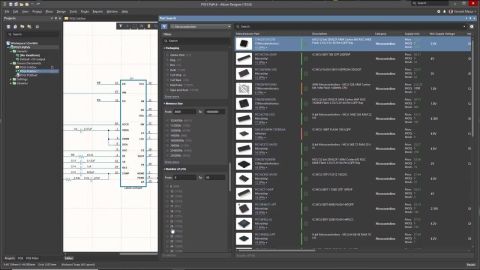
The advanced PCB design features and manufacturer part search tools in Altium Designer® make it easy to add a Bluetooth 5.1 SoC or module to your new IoT device. You’ll be able to quickly locate the parts you need from a simple part search, and you can immediately import them into your schematic and layout. You’ll also have access to the features you need to plan your next product for assembly and production in a single platform.
Now you can download a free trial of Altium Designer and learn more about the industry’s best layout, simulation, and production planning tools. Talk to an Altium expert today to learn more.

关于作者
Related Technical Documentation
相关资源
Solutions for Every Role and Team
- Discover and evaluate design options earlier
- Develop in one shared workspace
- Scale with control and compliance
- Connect every stage of hardware development
Learn More
Thank you, you are now subscribed to updates.


 沪公网安备 31010502006411号